Maurice Martenot
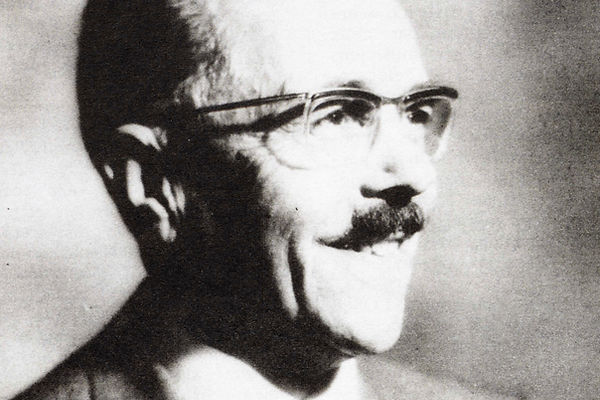
At the beginning of the 20th century, Maurice Martenot (1898-1980) developed one of the first electronic musical instruments, the Ondes Martenot (Martenot waves). It was first presented to the public in 1928 at the Paris Opera and, unlike many other early electronic instruments, found its way into classical orchestral instruments, film music and popular genres.
Martenot saw the limitations of conventional musical instruments. He perceived electronic sound as a new means of expression and the technical means as a way to overcome the limitations of conventional instruments. As a trained cellist with the knowledge of an engineer, he focused on the malleability of sound and expressiveness, which he wanted to be achievable with an electronic instrument. ...
Of particular interest [is] that the Ondes Martenot were not developed as simply electronic sound generator, but were also equipped with loudspeaker systems (diffuseurs) that enable special sound effects. Behind this was Martenot's idea of so-called ‘multi-resonators’, i.e. complex vibration systems that use loudspeaker coils to stimulate resonance and thus exploit the tonal properties of the vibration systems. ...
Around 1930, he invented a loudspeaker that used a flat gong as a resonance body (the ‘Metallique’) and, around 1947, another loudspeaker that used chromatically tuned resonance strings as a multi-resonator (the ‘Palme’). ...
In contrast to the concept of maximum fidelity in loudspeakers, diffusers actively alter the input sound material and generate their own sound qualities using complex vibration systems. The electronically generated sound is modified by acoustic means!
In the process, new technical possibilities are combined with concepts from traditional instrument making. Acoustic musical instruments require a resonance body for amplification, while electronic instruments require a loudspeaker. Martenot's inventions combine both principles. This electro-acoustic combination is historically almost unique and took place at the transition from mechanical to electronic sound generation.
(H. Herchenbach: Akustische Klangkörper für elektronische Instrumente. 2024)